







Description
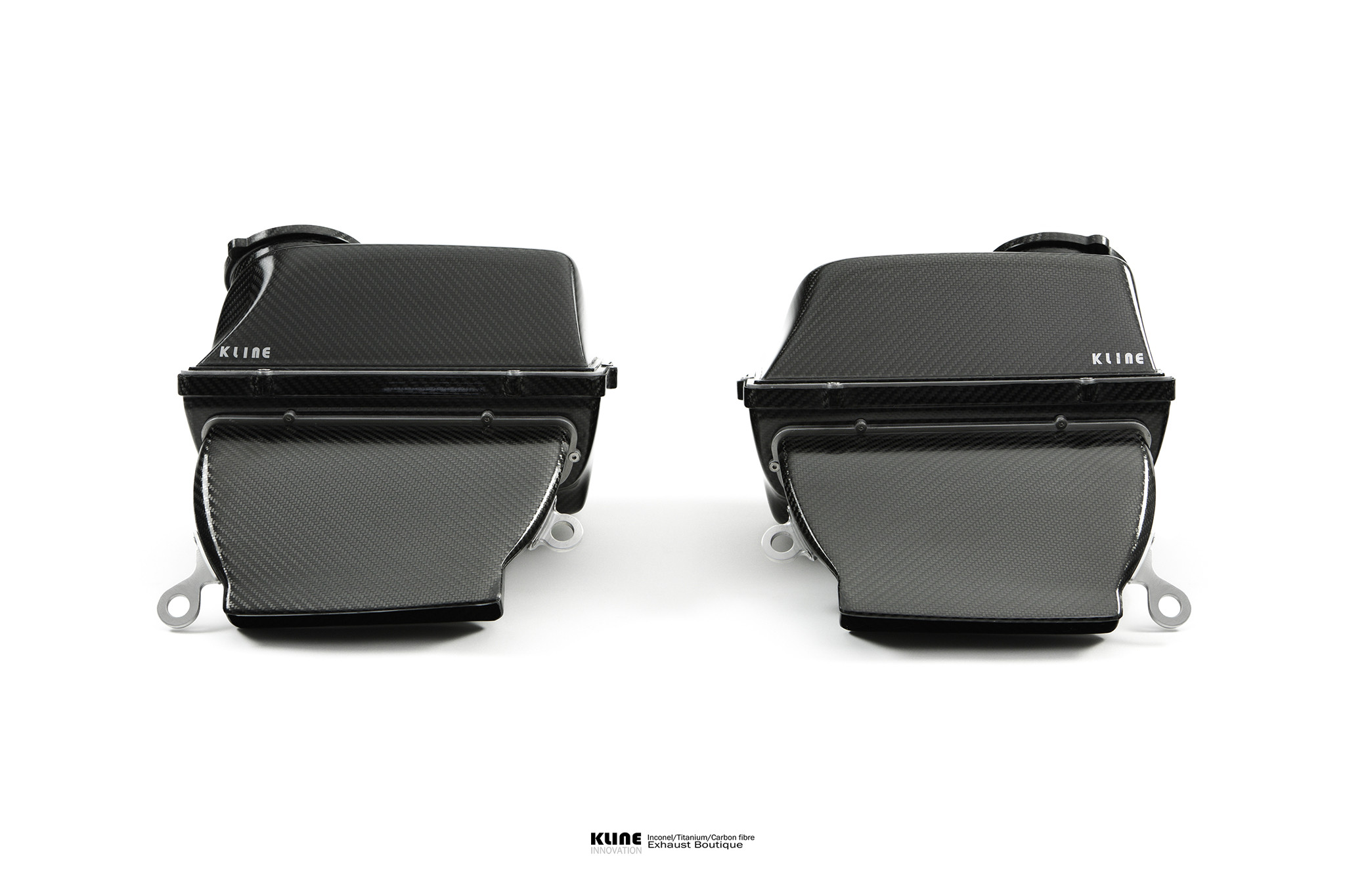
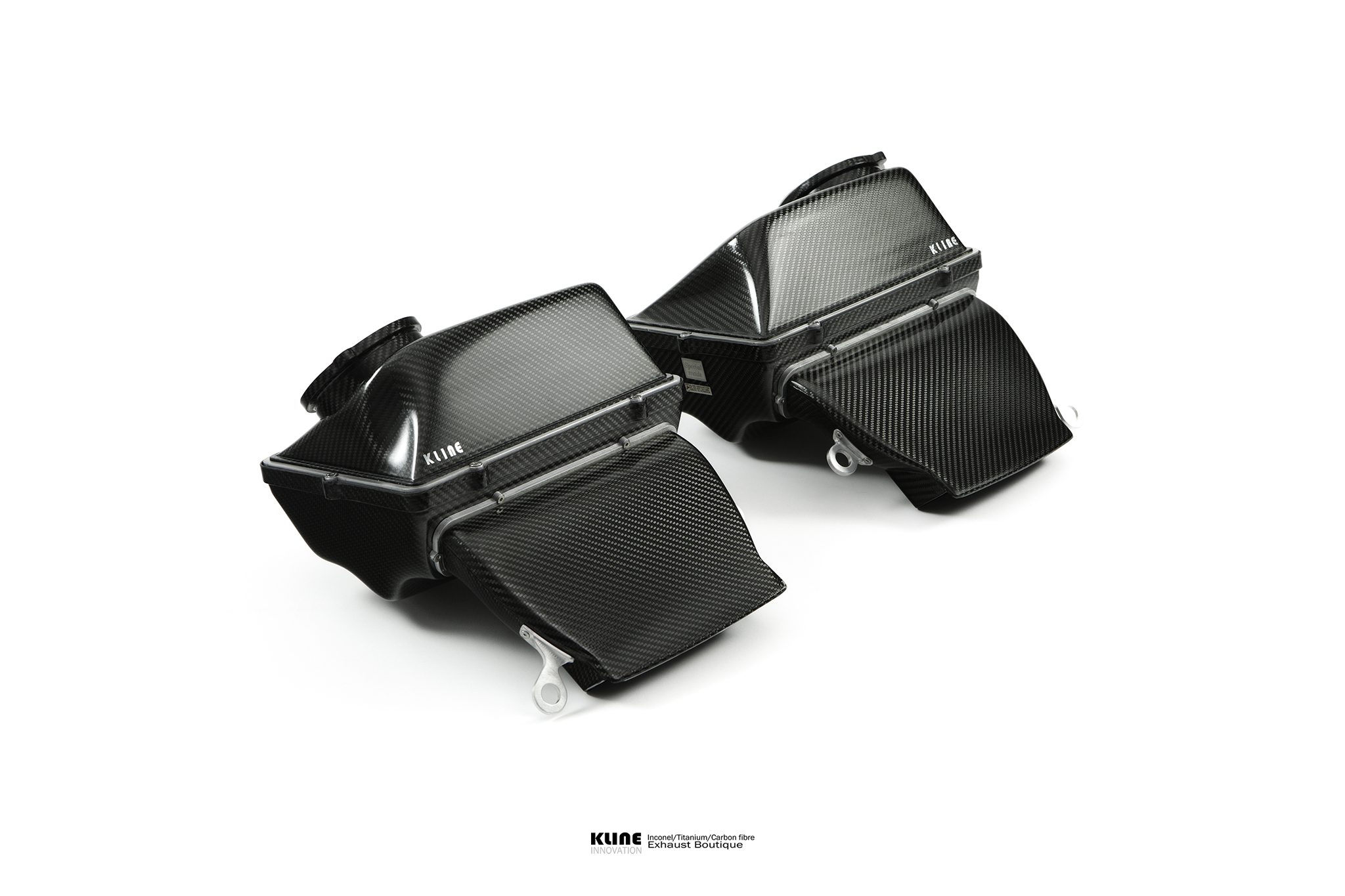
Kline Innovation Aston Martin Vantage Carbon Fibre Air Box Intake System
Kline Carbon Fibre Air Filter Box Aston Martin Vantage V8 (2018+)
Verified Vehicle Compatibility
Vehicle
- Aston Martin Vantage V8
- Model years: 2018+ (new-generation Vantage)
Engine
- Mercedes-AMG M177
- 4.0 L V8
- Twin-turbocharged
- Hot-V turbocharger configuration
- Direct injection
This air filter box is engineered specifically for the M177 intake architecture as implemented by Aston Martin, not for AMG Mercedes passenger car layouts.
OEM Intake System – Technical Constraints
The stock Aston Martin Vantage intake system prioritizes:
- NVH attenuation
- Packaging constraints under a low bonnet line
- Compliance with noise and emissions regulations
From an engineering perspective, the OEM airbox presents:
- Restricted inlet cross-section relative to compressor demand at high load
- Multiple flow direction changes prior to turbo inlet
- Plastic airbox construction prone to thermal soak in Hot-V environments
- Flow separation zones upstream of the compressor inlets
These factors increase:
- Pressure drop at the compressor face
- Compressor work for a given boost target
- Intake air temperature under sustained load
Kline Engineering Objectives
The Kline carbon air filter box is designed to:
- Reduce pressure loss between ambient inlet and turbo compressors
- Increase effective intake volume to support higher mass airflow
- Stabilize airflow into the compressors
- Limit heat absorption via material choice and enclosure geometry
- Maintain OEM sensor logic and ECU calibration
This is a functional intake enclosure, not a cosmetic replacement.
Measured / Observed Performance Effects
(Based on M177 intake behavior and independent workshop data)
Airflow Characteristics
- Increased inlet cross-section compared to OEM
- Reduced turbulence at compressor entry
- Higher stable mass airflow at high RPM and high load
Power / Torque Effects (Stock ECU)
- Peak power: typically +10 to +20 hp
- Peak torque: typically +10 to +15 ft-lb
- Primary improvement: throttle response and mid-range load recovery
Gains are driven by lower intake restriction, not by resonance tuning or ECU adaptation.
Component Breakdown
| Component | Technical Function |
|---|---|
| Carbon Fibre Air Filter Box | Primary intake enclosure, replaces OEM plastic airbox |
| Prepreg Carbon Fibre Shell | High stiffness, low thermal absorption, stable geometry under heat |
| High-Flow Panel or Cone Filters | Increased permeability compared to OEM while retaining filtration efficiency |
| Integrated Velocity Entry Geometry | Smooth inlet transitions to reduce boundary layer separation |
| OEM Sensor Mounting Provisions | Retains factory MAF/IAT sensor positions |
| Sealing Interfaces (Rubber / EPDM) | Prevents ingestion of engine bay air |
| OEM Mounting Points | Bolt-on installation without structural modification |
Material & Construction Details
- Carbon type: Pre-preg carbon fibre
- Manufacturing: Autoclave-cured
- Resin system: High-temperature epoxy suitable for Hot-V environments
- Internal surface: Smooth laminate to reduce friction losses
- Thermal behavior: Lower heat retention vs injection-molded plastic
Carbon is used here for:
- Dimensional stability under heat
- Reduced heat soak
- Structural rigidity under intake vacuum
Airflow Architecture Comparison
OEM Airbox
- Constrained inlet geometry
- Noise-oriented internal baffling
- Plastic walls absorb and retain heat
- Less stable airflow at high compressor demand
Kline Carbon Air Filter Box
- Increased effective inlet area
- Simplified internal geometry
- Reduced thermal mass
- More uniform airflow distribution at turbo inlets
Result:
- Lower pressure drop
- Improved compressor efficiency
- More consistent intake behavior under sustained load
Acoustic Impact
- Increased audibility of intake flow and turbo compressor operation
- No artificial sound generation
- No resonators removed downstream of the turbos
- Sound change is a by-product of reduced restriction, not a tuning goal
Installation & Integration Notes
- Direct replacement of OEM airbox
- No ECU calibration required
- All factory sensors retained
- No cutting or irreversible modification
- Installation time (experienced workshop): ~1–1.5 hours
Engineering Summary
- Engine: AMG M177 4.0 L twin-turbo V8
- Primary function: reduce intake restriction and heat soak
- Observed gains: ~+10–20 hp / +10–15 ft-lb (stock ECU)
- Main benefit: improved airflow stability and compressor efficiency
- Secondary effects: improved throttle response, reduced IAT under load
- No ECU upgrade required

Avis
Il n’y a encore aucun avis